Creative is a loop now
Smaller teams, fewer approval rounds, and a different agreement between agency and client.
P.J. Worsfold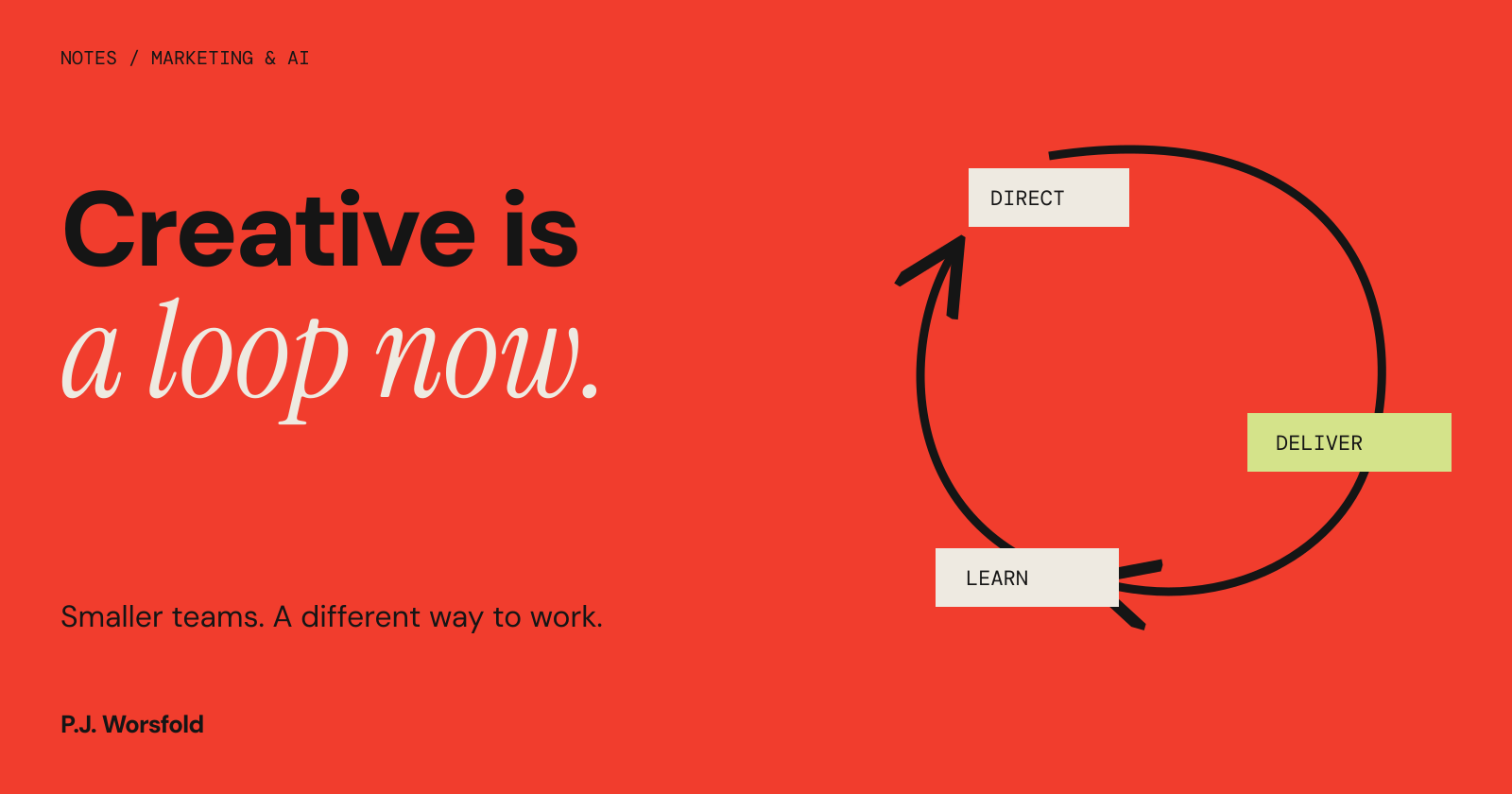
IN THIS NOTE (4) OPEN +CLOSE −
In January, I came across ohneis652. He’s doing outstanding creative work with AI. The ever-aspiring Kubrick/Warhol that lurks in me immediately got fired up. Then talent and time pulled me back, and I started thinking about how to relate what I saw to things I know about.
Here was work I’d happily put alongside agency creative, presented through one creator’s account. What would the small teams I work with need to produce work like this consistently? In a proposal I developed in March, I wrote: “The constraint has moved from capacity to execute to system design.” I imagined groups of two or three directing creative standards, AI production, and distribution, with results feeding back into the next project. It’s October 2026 and I’m sure this production utopia exists somewhere, but I’ve yet to come across it.
In You are now the producer, I asked what to make yourself and when to bring in help. Here, I’m interested in how that team could work.
Ethan Mollick’s HBR IdeaCast conversation gave me clearer language to work with. Ethan is a Wharton associate professor who studies AI’s effects on work. He describes job boundaries blurring as designers code and coders design. He also observes that AI skills increasingly look like management skills, particularly being able to say clearly what you want. I’d add critiquing the result and asking for revisions to that list.
It’s in this blurring that things get uncomfortable. Responsibilities overlap in ways decades-old department structures don’t accommodate. Managers can get nervous, corporate antibodies react, innovation gets stifled. Further still, system design now asks people used to wrangling pixels to play architect and chief of staff. We spent 30 years building the designer-and-developer workflow that AI is dismantling. We need time and practice to learn to make the pivot.
When the process fights back
And the legacy process itself fights you. Mollick points out that the organization eats productivity gains. Add AI without changing the process and “you end up with more of everything.” Consider the agency approval cycle: brief, presentation, feedback, revisions, another review, another round. Each asset becomes its own small project. There’s pressure to produce more variety for social distribution. Now supercharge with AI. The wheels fall off wherever humans hit the loop.

I’d like to explore a different agreement between agency and client for a standard marketing engagement. Think website, social, search, email. They meet and agree on audience, desired results, KPIs, mood board, and brand standards. They decide what the system can create and distribute, what needs approval, and when someone steps in. The agency then directs production and delivery within that agreement. When work falls short (poor engagement, weak conversion), the agency decides whether to change the strategy, creative direction, or the system’s instructions. The client keeps control; the agreement is where they exercise it. Audience response feeds the next round. Creative stops being a project and becomes a loop.
I’ll set a target I can’t yet defend: 90% less communication per asset.
The deal has to change too
Ninety percent is a dare, not a forecast, and my guess is the first thing to break is the invoice. For agencies pricing around hours or scope, the unit is often the deliverable and its rounds. Remove the rounds and the deal has to change with them. I’d change two things: pay more for results, and sign up for longer. A loop needs time to learn from the audience and compound. A six-week project may barely get a second lap.
Lighter upfront work could keep it viable for the agency, with part of the fee tied to improvement against an agreed baseline. The client would be paying for outcomes, and both parties would have a reason to pursue them. What’s left is a smaller team on a longer deal, accountable for improving results rather than completing a schedule of rounds. Designing that system is the work I want to do next. If you run an agency, or pay one, and want to try it, I’d like to hear from you.
The conversation
These links open the relevant moments in HBR’s YouTube version.
The fine print.
- 01CREATIVE REFERENCEohneis652: AI creative work ↗
- 02PODCASTEthan Mollick on how AI is changing strategy ↗
- 03BIOGRAPHYEthan Mollick: Wharton faculty profile ↗
- 04FIRST-HANDOrganizational proposal developed in March; a record of earlier thinking, not an implemented operating model.
- 05ARTWORK & CONTEXTDiagrams illustrate the proposed workflow. The 90% target is an ambition, not a measured result.